From the Checkout Cooler to the Pit Wall: What F1 Teaches Investigators About Better Investigative Interviews

Updated: 14 hours ago
Part 3 of a series on Science-Based Interviewing and grocery store psychology. Start with Part 1 and Part 2 if you missed them.
You didn't come to the grocery store for an energy drink.
You came for milk, the eggs, and maybe some bread. But now you're in the checkout line, you're tired, and the cooler is right there at eye level and within arm's reach. Grocers have studied this exact moment for decades: product placement, eye level, customer buying decisions, and getting better at how they sell. What you would describe as an impulse buy was already predicted and teed up for you by the grocer. The whole point of this series is about professions getting better at what they do. So grabbing that tasty Red Bull pick-me-up on your way out was intentional, another way retailers sell more products.
Now, turn the can over. The company behind it also runs one of the most test-obsessed organizations in professional sports: a Formula 1 team.
I'm not an F1 enthusiast. I couldn't tell you who won the last race. But I love watching the speed of pit crews and looking at the minute innovations that teams make that make a huge difference on the track. I am amazed by what these teams do to make improvements and by how relentlessly they do it.
I also had to find a way to move us out of the grocery store and on to other professions that test what they do. I settled on this segway while watching videos of F1 pit stops. An F1 team answers a question the interview and interrogation training has dodged for seventy years: what does a profession look like when it treats improving a core practice as the job?
Nobody wins in F1 with last year's car
Formula 1 teams spend their lives hunting for small advantages inside a thick Fédération Internationale de l'Automobile (FIA) rulebook. Then the rulebook changes, and they start over. Here are a few of the best-known innovations and examples.
The double diffuser (Brawn GP, 2009)
Three teams spotted a weakness in the underfloor rules and built a "double diffuser," a design that expanded the diffuser's working area and created extra downforce. Toyota and Williams had one. Only Brawn GP made it work to devastating effect. Jenson Button won six of the first seven races that season. The rules were then rewritten, and the design was banned from 2011 (Formula1.com; PlanetF1).
The F-duct (McLaren, 2010)
McLaren built a driver-operated system that stalled the rear wing, cutting drag and raising top speed. It was clever because it didn't count as a "movable aerodynamic device," which was banned. It lasted one season. The rule came down for 2011, and the Drag Reduction System (DRS) arrived the same year (Formula1.com).
The blown diffuser (Red Bull, 2010 to 2011)
Red Bull used engine exhaust gases to energize airflow at the rear of the car. When the sport's technical delegate moved to restrict blown exhausts mid-season in 2011, team figures pointed out that earlier innovations had only been banned at season's end. The governing body's answer drew a line worth remembering: clever readings of the rules are one thing, and using the engine as an aerodynamic aid was something it considered illegal (Auto123).
Dual-axis steering (Mercedes, 2020)
Mercedes let drivers push and pull the steering wheel to change the toe angle of the front wheels. Red Bull protested at the opening race, and the governing body ruled it legal for 2020. Then it rewrote the steering rule so the system could not return in 2021 (Autosport; The Race).
The pit stop, in hundredths of a second
Not every gain is a gadget. Red Bull's 1.82-second pit stop at the 2019 Brazilian Grand Prix stood as the record until McLaren did it in 1.80 seconds at the 2023 Qatar Grand Prix, and the newer cars and tyres are bigger and heavier (Crash.net). Two hundredths of a second. Teams chase improvement. Does your interview training?
What those stories have in common
They test. Nothing is assumed. Materials, shapes, procedures, and people all get measured against the clock and improved performance.
They keep score. A stopwatch does not care about seniority, reputation, or how many seasons you have been doing it this way. Compare that with an interview room where investigators never count their misses.
They adapt when the rules change, and nobody calls it an insult. When a rules ban lands, engineers do not argue that the old car was fine. They adapt and build the next one.
In law enforcement, the rule changes are called case law, statutes, better practices, and department policy. In private-sector investigations, they arrive as litigation, regulators, arbitrators, and discovery requests. Adapting to them is the part about being a good interviewer. It makes them better at their profession and more ethical, because the rules become the framework you build, and you adapt your method on.
Now put the 1950s car on the grid
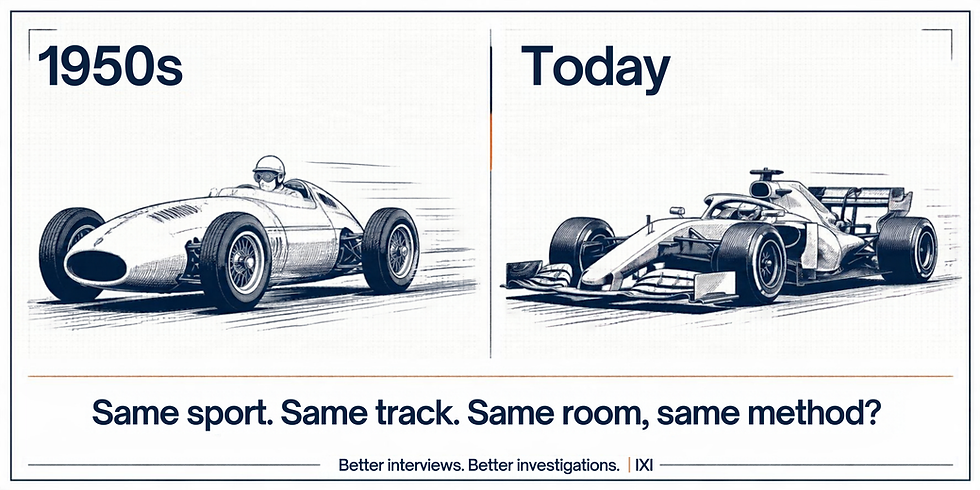
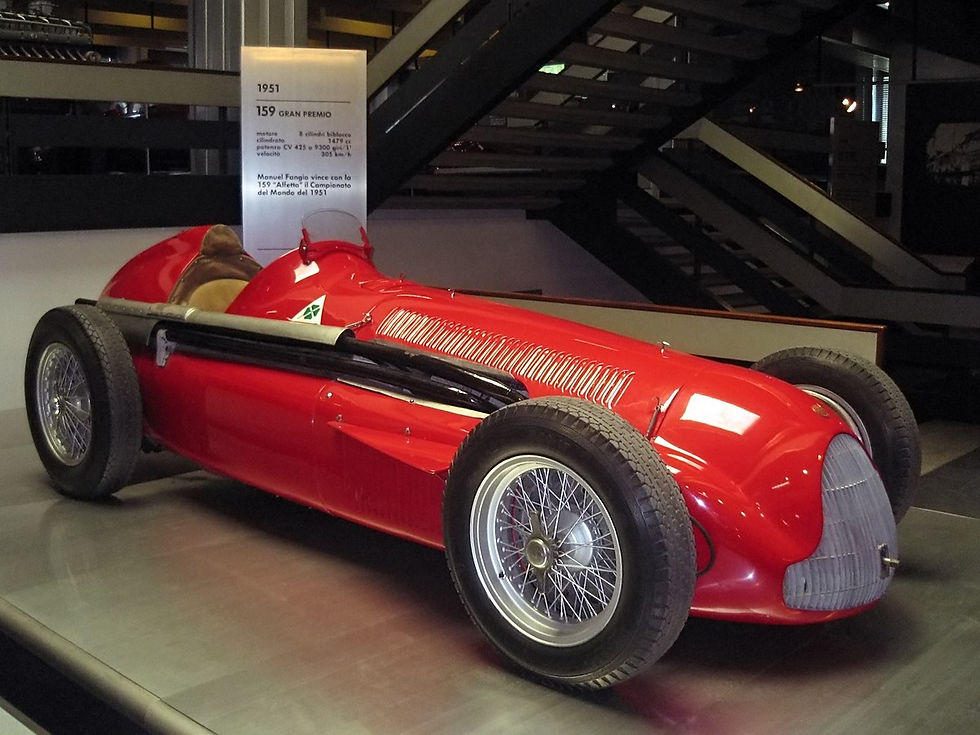
Imagine a 1950s Grand Prix car beside a modern one. Same sport, same track, both have tires and an engine, but they are nearly unrecognizable machines. Nobody in motorsport would agree that the first design peaked and further engineering improvements were pointless and unnecessary.
Use the same logic for the way we talk to people in high-stakes conversations. Have we learned nothing? We covered the famous question in Part 1: you have to believe there have been no breakthroughs in human communication research. No lab studies. No field validation. No surveys of the people who actually come into contact with the methods. That is a hard sell.
But there have been. A lot of them. Here is the short version, and the longer one lives in our comparison of science-based and legacy methods.
The government's own research and training group looked at the evidence and reached a clear conclusion. After reviewing laboratory and field studies, the High-Value Detainee Interrogation Group (HIG) concluded that the most effective practices for getting accurate information are non-coercive, rapport-based, information-gathering methods (HIG, 2016). A later review of the HIG research program noted that accusatorial methods lack an evidence base for producing confession evidence you can rely on (Meissner et al., 2017). Our HIG history post has the background.
The lab points the same way. A meta-analysis found that accusatorial methods raise the risk of false confessions, while information-gathering methods do not carry that risk (Catlin et al., 2024, Meissner et al., 2014).
The field points the same way. The field points the same way. When real investigators used science-based tactics on real cases, including violent crimes, suspects cooperated more and disclosed more. Confessions did not drop. Admissions rose along with cooperation. When accusatory tactics were used, suspects pushed back and gave less information (Russano et al., 2024, 2026).
ORBIT, the rapport-based approach developed by Laurence and Emily Alison through the HIG research program, was also tested in the field. It is built on more than 2,000 hours of real-world interviews with terrorist suspects, the largest data set of its kind in the world. In one published analysis of real police interviews with 49 convicted terrorists, interviewers who used more rapport-based skill saw less resistance from suspects, including fewer “no comment” responses and fewer attempts to shut the interview down (L. Alison et al., 2014). Researchers have since studied it with suspects in child sexual abuse cases, where the same pattern held: better engagement led to more useful information (E. Alison et al., 2022).
Prosecutors agree. In a California survey, prosecutors rated actively listening, confronting people with actual evidence, and pointing out contradictions among the most effective techniques. They rated insulting the suspect and not letting them answer among the least effective (Brimbal et al., 2026). The authors noted that many of the least effective techniques come straight from the legacy accusatory model's steps.
One more point, because you may hear it. Some legacy training materials claim the HIG's research "confirms" their approach, usually by pointing to a line about empathy or about telling a subject a story. Read the group's actual conclusion above. Empathy is part of good interviewing. What matters is what it is used for: understanding the person and gathering accurate information, not building a path to the lone goal of a confession. Pressure-based methods can produce confessions. Nobody disputes that. The dispute is about what else they produce: more resistance, less information, false case information, and a higher false confession risk.
Where F1 has a stopwatch, investigators have a stack of studies. Different instrument, same message: the old design loses because they are less effective.
Back to the checkout line
The can goes on the belt. You scan it, pay, and forget about it.
Somewhere, a team of engineers and mechanics is shaving hundredths of a second off a tire change. The cooler by the register was placed by people who tested the endcap and the placement. The interview room, where we decide what is true, can get the same respect and it should be given the weight of the situations investigators get involved in.
Yes, we sell science-based interviewing. Here is the difference: it is a non-proprietary methodology whose claim isn't we are the best. Our claim is we are a proven, improved investigative practice that will be adapting as the science tells us what is more effective. proven. Here are some things to question vendors on. Ask where a method was tested, who tested it, and what happened to the people who used it. If the answer is a story, keep shopping. If it is a citation, a field study, and investigators who stayed with it, you are looking at the upgrade.
Better investigative interviews. Better investigations.
I’ll be honest, I bought the can. Now I just need Red Bull to sponsor some research. We have some ready to go. Red Bull? Please?
Let's see how I get out of the grocery store next time.
Ready to upgrade your team's process? Explore our training, online options, and science-based interviewing overview.
PS - Hey Red Bull!
Hey, Red Bull. I love the racing, the soapbox derbies, the cliff diving, the stunts, and the general awesomeness. You’ve never been shy about funding people who want to find out what’s possible. So how about sponsoring some research into more effective investigative interviewing? We have projects ready to go. Please?
Better Investigative Interviewing References
Alison, E., Humann, M., Alison, L., Tejeiro, R., Ratcliff, J., & Christiansen, P. (2022). Observing Rapport-Based Interpersonal Techniques (ORBIT) to generate useful information from child sexual abuse suspects. Investigative Interviewing: Research and Practice, 12(1), 22–39.
Alison, L., Alison, E., Noone, G., Elntib, S., Waring, S., & Christiansen, P. (2014). The efficacy of rapport-based techniques for minimizing counter-interrogation tactics amongst a field sample of terrorists. Psychology, Public Policy, and Law, 20(4), 421–430. https://doi.org/10.1037/law0000021
Brimbal, L., Hill, S. L., Maguire, E. R., & Soderstrom, M. F. P. (2026). Prosecutors' perceptions of the effectiveness of police interview practices. Psychology, Crime & Law. https://doi.org/10.1080/1068316X.2026.2700431
Catlin, M., Wilson, D., Redlich, A. D., Bettens, T., Meissner, C., Bhatt, S., & Brandon, S. (2024). Interview and interrogation methods and their effects on true and false confessions: A systematic review update and extension. Campbell Systematic Reviews, 20(4), e1441. https://doi.org/10.1002/cl2.1441
High-Value Detainee Interrogation Group. (2016). Interrogation: A review of the science. Federal Bureau of Investigation. https://www.fbi.gov/file-repository/hig-report-interrogation-a-review-of-the-science-september-2016.pdf
Meissner, C. A., Redlich, A. D., Michael, S. W., Evans, J. R., Camilletti, C. R., Bhatt, S., & Brandon, S. (2014). Accusatorial and information-gathering interrogation methods and their effects on true and false confessions: A meta-analytic review. Journal of Experimental Criminology, 10(4), 459-486. https://doi.org/10.1007/s11292-014-9207-6
Meissner, C. A., Surmon-Böhr, F., Oleszkiewicz, S., & Alison, L. J. (2017). Developing an evidence-based perspective on interrogation: A review of the U.S. government's High-Value Detainee Interrogation Group research program. Psychology, Public Policy, and Law, 23(4), 438-457. https://doi.org/10.1037/law0000136
Russano, M. B., Meissner, C. A., Atkinson, D. J., Brandon, S. E., Wells, S., Kleinman, S. M., Ray, D. G., & Jones, M. S. (2024). Evaluating the effectiveness of a 5-day training on science-based methods of interrogation with U.S. federal, state, and local law enforcement investigators. Psychology, Public Policy, and Law, 30(2), 105-120. https://doi.org/10.1037/law0000422
Russano, M. B., Meissner, C. A., Jones, M. S., Rothweiler, J. N., Taylor, P. J., Cory, C., & Brandon, S. E. (2026). Evaluating the effectiveness of a practitioner-designed science-based interviewing and interrogation course: A collaborative training and research effort. Legal and Criminological Psychology, 31, 273-300. https://doi.org/10.1111/lcrp.70021


Comments