Shadows on the Wall: The Allegory of the Cave and Interview and Interrogation Training
Plato asks you to picture prisoners who have been chained in a cave since childhood. They face a blank wall. Behind them burns a fire, and between the fire and the prisoners, people carry objects along a walkway. All the prisoners ever see are the shadows those objects throw on the wall.
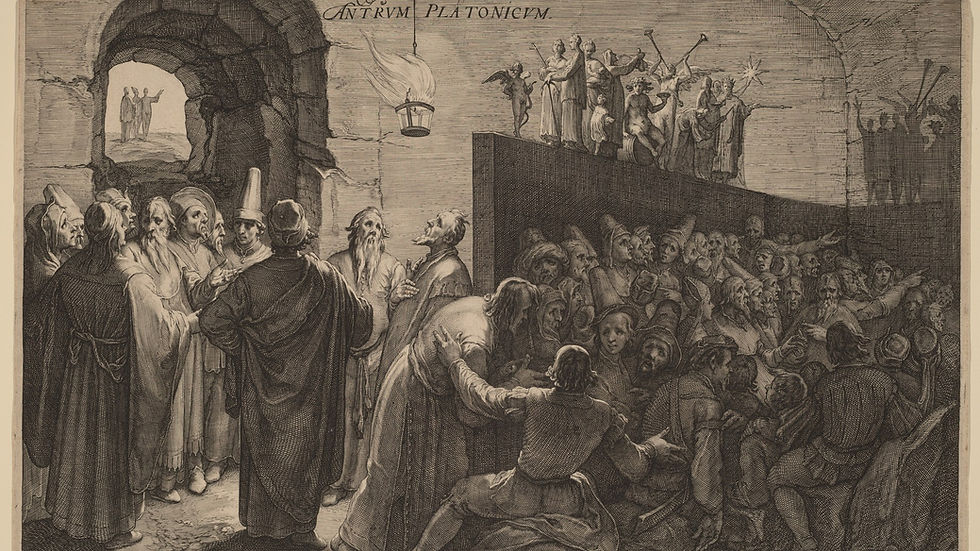
The shadows aren't lies, exactly. They're real shadows. They move, they have shape, and they behave predictably enough that a prisoner can get very, very good at knowing them. The prisoners give the shadows names. They compete over who can predict the next one. They build entire methods on what the wall shows them.
Those methods are worthless the moment you turn around.
This is the most useful story I know for explaining the state of interview and interrogation training in the United States—in policing and just as much in loss prevention, human resources, compliance, and corporate investigations. We have spent seventy years getting extremely skilled at reading shadows and largely ignored what has been emerging this century.
The Chains: "This is How We've Always Done It"
Almost everything else about investigative work has been upgraded. Evidence collection, forensics, records, analytics, use-of-force policy, equipment, and documentation have all improved, and we now have more evidence available to investigators than ever before. Whole categories of accepted practice have quietly gone by the wayside because something better came along and the field moved.
But we have not changed how we communicate with human beings. Not the interview. We still largely run that one the way it was designed in the 1950s—and the argument for keeping it is a bad one. It's a sentence: "This is how we've always done it," or as one Chief told me "it was good enough for me; it is good enough for them." That is the most succinct definition of mediocrity I have ever encountered.
I want to be clear that I am not describing other people. I was chained to that wall too. I ran interviews the way I was taught, believed what my instructors told me, and never once asked to see the data—because it never occurred to me there was data to see. Nobody in that room had any malice. That's the point. The chains don't feel like chains. They feel like the floor.
And the chains reach far past the police precinct. Loss prevention, HR, internal audit, corporate security, and compliance—private-sector investigative interviewing inherited the same legacy methods, usually from the same vendors, often taught by the same instructors, and frequently in settings with far fewer safeguards and case law than a police interview room has.
The Shadows: The Maxims We Mistook for Knowledge
The oldest shadow is the one still holding up the wall: confessio est regina probationum—confession is the queen of proofs. Under the Roman-canon law of proof that governed European courts for centuries, a capital conviction required two eyewitnesses or a confession. Circumstantial evidence, however damning, was only half proof. So when there were no witnesses, the system needed a confession, and torture became the legal instrument for producing one. The maxim didn't describe how proof worked. It dictated what interrogators were required to go get.
The people running that system were not villains. They were applying the law of proof as they understood it, and it produced exactly what it was built to produce, in volume, for centuries.
The queen of proofs made sense in a world that had no other proof. We don't live in that world anymore. But look at what still gets projected on the wall in a standard legacy accusatorial interview and interrogation training course, and you'll find her still on the throne:
"No one would ever confess to a crime they didn't commit." Roughly one in four DNA exonerations involved a false confession or incriminating statement. The maxim isn't a small error. It's the load-bearing wall of the entire legacy structure. Don't take my word for it—work the cases backward yourself. Start at the exoneration, walk back to the interview, and then walk back further to the moment someone decided they already knew.
"A trained investigator can tell when someone is lying." Not with junk science. Decades of research put accuracy near chance, and feedback in the real world is so poor you can't learn from your own mistakes. Confidence goes up with training. Accuracy doesn't.
"Determine guilt, with 'lie detection,' then move to get the confession." That is guessing, dressed as a method that will include scientific-sounding vocabulary. Then the rest of the interview goes looking for agreement instead of information and it has one goal.
"Pressure produces truth." It produces statements. Those aren't the same thing, and the difference is where cases and reputations die.
Every one of those is a shadow—consistent, teachable, predictive-feeling, and disconnected from the object casting it.
What Is Your Plan If They Don't Confess?
Now let me ask the question I've put to a lot of rooms full of professional investigators. Have you ever won a case in court without a confession? Nearly every hand goes up. Every time.
So confessions aren't the point. They're a good outcome, and nobody doing science-based interviewing is against them—the research says you get more of them, not fewer. The problem is the goal shift. The moment a confession becomes the lone objective, everything else you could have walked out with stops counting as a win.
And there is a lot to walk out with.
A false exculpatory statement—or a negative statement, as we called it in my jurisdiction—is a lie you can prove is a lie, not gaze aversion, micro-twitches, or wiggly fingers. It's one of the strongest things you can put in your case file. Across two mock-juror studies, exposed lies about evidence produced conviction rates no different from a confession, and stacking a confession on top of exposed lies added nothing further (Brimbal & Jones, 2018). The difference actually favors the known lies: exposed lies pushed jurors to scrutinize the physical evidence and rate it as more probative, while a confession worked as a shortcut—jurors saw it and stopped evaluating the rest of the case. The authors' conclusion: "the probative value of a defendant's exposed lies about evidence is no different from a confession. In both cases, a conviction is likely."
And exposed lies are only one item on the list. Multiple, shifting accounts—now the person has to sit on a stand, under oath, and explain why the story changed three times, and my prosecutor is going to ask. An alibi that collapses against a single phone record. A timeline that doesn't survive the digital footprint. A detail only someone who was there would know. Names, places, times, and relationships that open a lead you didn't have when you walked in. And the alternatives you eliminated—which is how a case gets stronger even when the person in the chair turns out not to be the one who did it.
None of that requires an admission. All of it requires the person to keep talking.
Which brings me to the question I ask every legacy-trained investigator, and I have never gotten a good answer: what is your plan if they don't confess?
Because that is most of the time. And by then you've spent your evidence, rejected every denial, told them what you already "know," and burned the rapport you'd need to get anything else done. In some cases you've burned your competence in their eyes—they've watched you insist on something they know isn't true, and now nothing you say carries any weight with them. You have no plan B, because the method never built one. There was one exit from that room and they didn't take it. By the way, your DNA results, toxicology, and any other forensic testing will be back in weeks, if not months. I'll bet you have more questions then. "Lone goal," you say?
Science-based interviewing has a plan B, C, and D. They're called information.
The Fire: Rebranding Is Not Sunlight
Here's the part of the allegory people miss. The prisoners aren't in the dark. There's light in the cave. It's just artificial light, tended by someone, positioned specifically to make the shadows.
That fire is the marketing.
Walk any training expo and count the courses now calling themselves non-confrontational, non-accusatory, research-based, science-based, or PEACE-adjacent. Open the actual curriculum and you find the same 1950s architecture wearing a new coat: presumption of guilt, theme development, denial control, prisoner's-dilemma tactics, minimization, and a march toward admission. It usually comes with a shelf of junk and pseudoscientific lie detection—neurolinguistic programming, "baselining," microexpressions, and behavior-provoking questions. None of it survives contact with the research and, in my experience, the real world. Some are even hybrids or Frankenstein curricula—legacy bones with a rapport module bolted onto the front. The hybrids are sometimes more coercive than the originals.
I'd bet many chiefs, sheriffs, and training directors would be genuinely appalled if they sat through the full curriculum their people were sent to last quarter. Most have never seen it. They approved an interview and interrogation vendor, not a method.
Watch for the tell in the sales copy: it's all about the truth. It can't be about the "truth" if the tactics reliably produce less information.
Two Interrogation Paradigms: One Wants Information, the Other Wants a Confession
Here is what most of the marketing is designed to obscure from investigators, practitioners, and training decision-makers. There are not fifty methods of interviewing. There are two interview and interrogation paradigms, and every course on the market is downstream of one of them.
Information-gathering—the science-based paradigm. The goal is to collect the most accurate, uncontaminated information from the person in front of you and test it. This is for the interview and interrogation; the goal is always the same.
Legacy Accusatory—the objective is a confession. Everything in the process is instrumental to that end — including the pseudoscientific behavioral analysis and lie detection woven through it, which exists to tell the interviewer they already know the answer.
Those objectives are not merely a slight difference. They are antithetical. They pull the interviewer in opposite directions at every decision point in the room, and when the two are combined, the accusatory objective wins—because a goal is not a module you can add. It's the thing that decides what every other technique is for. That's why hybrids taught under various names by different vendors—or officially, like the RCMP's Phased Interview Model—keep reimporting the legacy risk factors they were supposed to leave behind. A peer-reviewed analysis of PIM found three practices carried straight over: minimizing culpability, mischaracterizing evidence, and asking leading questions to commit a suspect to an answer (Snook et al., 2020). Their explanation of why is the empirical version of the point: "Well-practiced and routinized tactical approaches compete with newly learned, yet ill-practiced, techniques gleaned from training, leading to a seemingly disorganized interview strategy that lacks conceptual coherence." Under pressure, the trained-in habit wins. The bolted-on technique is the one that gets dropped.
Watch how the same vocabulary means two entirely different things depending on which paradigm owns it.
"We build rapport." Both say it, and it is the single clearest place to see the two paradigms come apart.
In the accusatory paradigm, rapport is a setup for persuasion. It exists so the interviewer can develop themes. It exists so the subject will be receptive when it's time to be moved toward admission. It is instrumental and conditional, and it evaporates the moment the interviewer decides the subject is guilty.
You don't have to take my word for how instrumental it is. The legacy confession-driven apologists say so themselves. Read it closely and you will find guidance cautioning investigators to be wary of anyone who overemphasizes rapport—advice to not get preoccupied with it, because rapport is already built into their proprietary checklists (they aren't tested either). Work the steps and you'll have all the rapport you need.
Sit with that for a second, because it's an admission hiding inside a caution.
Rapport is the most reliable endeavor we have for increasing how much a person cooperates and how much they tell you. That isn't a contested finding. More rapport, more information yield—across victims, witnesses, cooperative subjects, resistant ones, and terrorists. So when a legacy curriculum advocate tells investigators to ease off rapport and trust the sequence, he is telling you plainly what legacy techniques optimize for, and it isn't information. Nobody rations the one thing that increases information yield unless yield was never the point.
In science-based interviewing, rapport is not a phase. It's a working condition that raises information yield across the interview. There's no step in the process where you're advised to stop building it. It doesn't get switched off when the interview gets hard. In fact, it is not about being friends or being soft, it is about the information.
"We ask open-ended questions." One of them means they open with a broad question and then narrow into a theme. and then narrow into a theme. Science-based interviewing means something far more demanding:
Open-ended questions built to stay contamination-free—no facts of the case fed into the question
Free narrative first, uninterrupted, before any probing. Breadth and depth
Cognitive interviewing components with demonstrated effects on recall — context reinstatement, report-everything instructions, varied retrieval
Memory-compatible questioning that follows how retrieval actually works instead of fighting it
Autonomy, evocation, and honesty built into how the conversation is framed—the account is drawn out, not supplied
Testing veracity through Strategic Use of Evidence to determine whether the information you're getting is an uncontaminated, corroborated statement
That is not the same as saying, "we ask open-ended questions." Science-based interviewing is an entirely different interviewing discipline, and the shared phrases and terms hide the gap. This is what legacy accusatorial systems want; they want to seem like they are backed by research when they aren't.
And the two paradigms handle evidence in opposite directions. We have more evidence available now than at any point in the history of this work—digital records, video, location data, automated license plate readers (ALPR), smart phones, and door bell surveillance cameras. The accusatory paradigm spends it. Evidence gets disclosed early and confrontationally as ammunition to overwhelm denials. The moment you do that, you've contaminated everything the subject says afterward and destroyed your ability to test the account against what you already know. You cannot unring that bell.
The science-based paradigm treats evidence as the instrument of verification: withhold it, let the account run its full length, then disclose deliberately and see whether the story survives contact with the file.
Disclose early and you have spent your evidence. Disclose strategically and you will have tested it.
So when a vendor tells you their course is non-accusatory, ethical, and based on research, don't argue about the label. Ask two questions.
First: what is the goal of the interrogation? If the honest answer is a confession, everything else—including the non-threatening adjectives—is just decoration.
Second: how do you test credibility? This one is harder to dress up, because the answer has to be a method rather than an adjective. If it comes back as reading the person—baselining, microexpressions, body language, NLP, or behavior-provoking questions—you are in the accusatory paradigm no matter what the cover of the binder says. Those tools don't test an account; they create false case information and statement contamination. They tell an interviewer what to believe about a human being, and then the rest of the interview goes to work confirming it. If the answer is Strategic Use of Evidence and/or cognitive practices—testing the statement against the evidence, against itself, and against what a truthful account is actually able to produce—you're in the information-gathering paradigm.
One tests the person. The other tests the account. Only one of those produces evidence.
Two questions. The goal and the credibility test. You'll know which paradigm you're buying inside five minutes.
Turning Around: What Happens When You Actually Look
The prisoner in the allegory doesn't get argued out of the cave. He gets turned around. He sees the fire, the walkway, and the objects—and eventually the sun outside, which is what was real the whole time.
In our field, turning around means science and field validation. Not classroom satisfaction sheets. Not testimonials. Recorded, coded, real interviews in real agencies were scored against outcomes.
This work has been done across multiple agencies, four states, two Major Cities police departments, varying agency sizes, and federal investigators. The pattern from your peer investigative practitioners repeats:
Science-based tactics are associated with more cooperation, which drives more information disclosure, which in turn is associated with more admissions and confessions (Russano et al., 2024; Russano et al., 2026).
Accusatory tactics are associated with more counter-interrogation behavior from the subject — resistance, guardedness, strategic withholding — and less cooperation and less information (Russano et al., 2024; Russano et al., 2026).
Read that pairing again, because it dismantles the oldest defense of legacy methods. The confrontational approach doesn't trade information for confessions. It loses on both metrics. The science-based approach garners more cooperation, more information yield, and more admissions.
And less information is never good for an investigation. Not in a homicide, not in a sexual harassment complaint, not in an inventory shrink case. Less information doesn't just slow you down—it bends the picture. It skews the truth. An interview that suppresses detail produces a case file that is a lot thinner than the real-world incident. Commanders, corporate security leaders, attorneys, and investigations managers, I now have a question. Would you rather make a big investigative decision or employment decision based on more information or less?
Why the Shadow-Readers Won't Turn Around
Plato's prisoners don't thank the man who came back. They mock him, and they'd hurt him if they could.
The modern version is subtler and easier to spot once you know the move. Legacy vendors claim the words "research-based" and "science-based" while resisting the one thing that would settle the question: measurement. Ask for researched proof and/or field validation of their methods and watch what happens.
The proof is that they want it both ways. When a metric favors them, it's proof. When a metric doesn't, suddenly the research "isn't the real world," "can't be tested," or "doesn't reflect what happens in the box." A standard that only applies when you pass it isn't a standard, it's a shadow you've agreed not to look behind. After all, I have a higher batting average than Ted Williams and Ohtani when you don't count my misses.
Nobody Is Coming to Protect the Investigator
England could largely shut the bad training off. After their own false confession scandals, Parliament passed the Police and Criminal Evidence Act (PACE) in 1984, which put suspect interviews on tape. Once researchers could finally hear what was happening in the room, the old approach became indefensible—and in1992 England and Wales replaced it with the PEACE model of investigative interviewing: Planning and Preparation, Engage and Explain, Account, Closure, and Evaluation. The legacy material lost its footing. I've heard people say we should just do that here.
We can't, and mostly we shouldn't want to. We're governed by federalism, states' rights, and local control of policing. These are good things. Chiefs, sheriffs, and training directors pick their own vendors. I'm not trying to take that autonomy away from anyone. The private sector has the same structure—an HR director, a security VP, or an L&D manager signs a purchase order, and that's the method your organization now uses.
But understand what that freedom means when something goes sideways. When a confession gets suppressed, when a termination becomes a lawsuit, when a case unravels on cross-examination and the interview is the reason, the vendor who sold you the method will not be sitting at that table. Not the instructor. Not the company. Not the certificate on your wall. It's you, your file, and your reputation.
And consider what you'd be defending. These are lines from legacy interview and interrogation curricula taught to investigators since 2022:
"The object of an interrogation is to induce stress."
"Block the denial, then immediately re-accuse." And "don't let the re-accusation turn into an argument—take control."
Tell them you have satellite photos (because Google Maps)
Do not allow the suspect to relieve stress. No gum. Don't let them pace.
"More guilty pleas = no court."
Now read those out loud, in your own voice, under oath. How defensible do they sound?
That last one is the tell. It isn't about the truth. It was never about the truth. It's about closing.
And it does not stop at suspects. The same curricula teach investigators to "evaluate the reliability of the information provided by a victim," and promise to "help you to rule out the truthful person and pinpoint the deceptive one, including victims.
Think about what that means operationally. Trauma disrupts memory. Accounts come out fragmented, out of order, and inconsistent on retelling—which is precisely what these pop-psychology behavioral checklists score as deception. So the pseudoscience doesn't only risk false information on your case or a false confession from a suspect. Pointed at a victim, it manufactures a false report. Domestic violence and sexual assault advocates have been saying this about law enforcement interviewing for decades. They have been right.
And it travels into the private sector unchanged. An HR investigator deciding whether a harassment complainant "seems credible" based on eye contact and demeanor is running the same junk science playbook, with the same failure mode, on the person who came to them for help.
That's the moral case. Here's the self-interested one: as an investigator, don't you want the version that's backed by research when your work gets scrutinized?
This Is Upgraded Communication, Not an Indictment.
I want to say this plainly, because it gets misheard and misunderstood all the time.
None of this is a personal attack on how you've conducted business, and it isn't an indictment of your ego. Investigators who used these methods, like me, were trained poorly. That's a curriculum failure, not a character failure. You had no malice in how you approached the job. Neither did I.
The ask is a professional upgrade. Get rid of the old maxims. Get away from techniques that demonstrably reduce the amount of investigative information you collect and include false information and false confession risk factors. That upgrade improves your investigations and, in turn, your investigative decisions. It lowers your risk. It raises your standing—personally and for your organization.
And it doesn't require a policy overhaul to start. It starts on the next call. The next door you open. The next employee who sits down across from you. The next difficult conversation you were dreading. It starts with the next TED question—Tell me. Explain. Describe—instead of the next accusation.
The rest is discipline: plan the interview, manage disclosure of evidence deliberately, and keep testing your own theory instead of defending it. That last one is why we red team—deliberately continuing to think, closing off the escape routes in your reasoning, and finding the weak seams in a case before someone else finds them for you. A structured peer review does the same job at the investigative team and organizational level.
Put Your Training Dollars Where Your Mouth Is
Here's my whole pitch...
Science-based interviewing is about putting evidence-based techniques in the hands of investigators so they gather more information for their cases. More information is better for justice. More information is better for victims. More information is better for the organization that has to act on the findings. And it is more effective than what most people were taught.
You have a choice. One option is the way it's always been done—demonstrably less effective, built on junk science and old maxims. The other is science-based methods that are clearly more effective. I can't put it any other way, and there isn't another way to put it.
If it really is about the truth, put your training dollars where your mouth is.
That's what IXI and Project Alethia exist to do—help police executives, training coordinators, investigation commanders, training directors, and their private-sector counterparts sort out what is science-based and what is merely marketed that way. And yes, you may love your past instructor. I've heard that many times, and in more than one case I liked the guy too. That's not evidence-based. Liking your instructor doesn't mean they're teaching effective ways to communicate with another human being on the other side of every patrol car door, every HR conference table, and every interview room.
The prisoner who walks out of the cave doesn't receive a finished picture of the world. He gets daylight and the ability to keep looking. Evidence-based practice is the same deal: it's a standard you can actually rely on, and it's poised to get better as the research improves.
That's not a weakness. That's how science works.
Ready to see what's outside the cave? Explore our workshops, our SBI Train-the-Trainer for your entire agency, or our on-demand SBI MicroTraining, or start with the basics.
Interview and Interrogation Training References
Brimbal, L., & Jones, A. M. (2018). Perceptions of suspect statements: A comparison of exposed lies and confessions. Psychology, Crime & Law, 24(2), 156–176. https://doi.org/10.1080/1068316X.2017.1390111
Kassin, S. M., Drizin, S. A., Grisso, T., Gudjonsson, G. H., Leo, R. A., & Redlich, A. D. (2010). Police-induced confessions: Risk factors and recommendations. Law and Human Behavior, 34(1), 3–38. https://pubmed.ncbi.nlm.nih.gov/19603261/
Langbein, J. H. (1977). Torture and the law of proof: Europe and England in the ancien régime. University of Chicago Press.
Meissner, C. A., Redlich, A. D., Michael, S. W., Evans, J. R., Camilletti, C. R., Bhatt, S., & Brandon, S. (2014). Accusatorial and information-gathering interrogation methods and their effects on true and false confessions: A meta-analytic review. Campbell Systematic Reviews. https://www.campbellcollaboration.org/review/interview-interrogation-effects-on-investigations/
Plato. Republic, Book VII (the Allegory of the Cave).
Russano, M. B., Meissner, C. A., Atkinson, D. J., Brandon, S. E., Wells, S., Kleinman, S. M., Ray, D. G., & Jones, N. J. (2024). Evaluating the effectiveness of a 5-day training on science-based methods of interrogation. Psychology, Public Policy, and Law, 30(2), 105–120. https://doi.org/10.1037/law0000422
Russano, M. B., Meissner, C. A., Jones, N. J., Rothweiler, J. N., Taylor, D., Cory, C., & Brandon, S. E. (2026). Evaluating the effectiveness of a practitioner-designed science-based interviewing and interrogation course. Legal and Criminological Psychology, 31, 273–300. https://doi.org/10.1111/lcrp.70021
Snook, B., Fahmy, W., Fallon, L., Lively, C. J., Luther, K., Meissner, C. A., Barron, T., & House, J. C. (2020). Challenges of a "toolbox" approach to investigative interviewing: A critical analysis of the Royal Canadian Mounted Police's (RCMP) Phased Interview Model. Psychology, Public Policy, and Law, 26(3), 261–273. https://doi.org/10.1037/law0000245


Comments